Day 4: Night falls on Segment 1 (in progress)

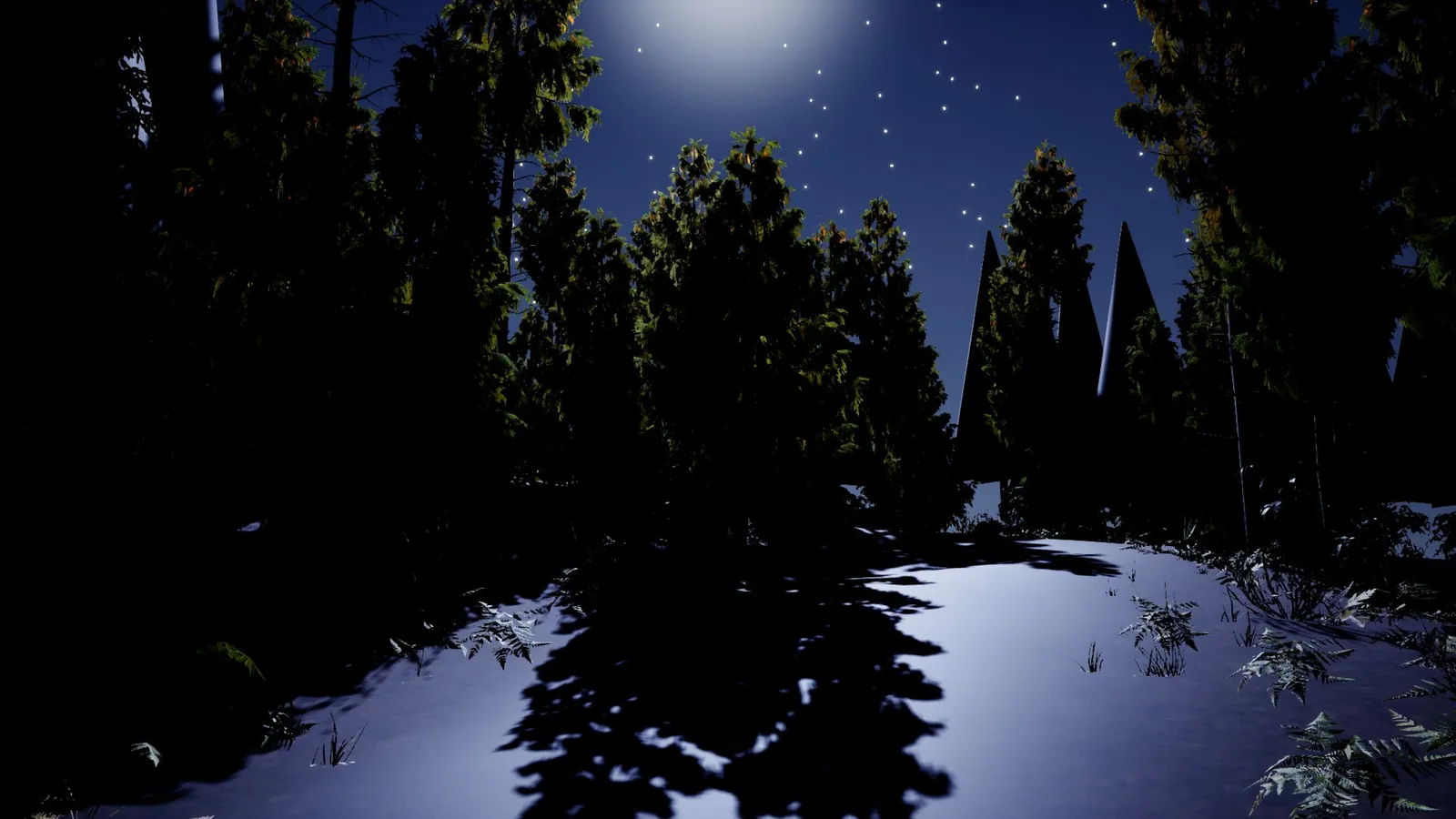
TL;DR: This entry is still being written and will grow through the day. Overnight the game got its real menus and its first special enemy. By breakfast Segment 1 had become a moonlit night, the front end led straight into a playable run, the bots had learned to spread out, and the Briar Warden had started to appear in the distance. Joel also set the priority for the final stretch: make single player look and feel great first. Then the night pass broke the spawn point, which is where we are right now.
Overnight: menus, specials and armour
Codex and Claude kept going while Joel slept. The native menu screens and a compact HUD went in at 3:21 AM (PR #102). This was the UI rework we’d been building towards since Friday: the mockups and the medieval art kit, rebuilt as real screens in C++ so Codex could build and test them without anyone watching. Next to it came the director’s special spawning and horde requests (PR #103), so the pressure director can now send specials and hordes at you rather than just track how you’re doing.
At 5:40 AM the first special with its full behaviour arrived: the Strawman (PR #104). It hides among the scarecrows in the fields, and you won’t know which one it is until it moves. At 6:18 AM the Guard’s modular armour went in, with leather and plate pieces fitted to the shared skeleton (PR #105). It’s the first proof that our heroes can visibly upgrade their gear.
Morning: Joel plays it, and makes the calls
Joel picked up the build over breakfast and gave us a run of decisions.
The first was the camera. We’d always planned first person, and the build was third person. So first person is now the default, and one key (V) switches to third person. In the first version you could look down and see your whole body, with no head. Joel’s note was simple: you should see your arms and legs, not a headless body. That change is being made before it goes in.
The second was the castle. Joel looked at the courtyard and wrote, “this is not a castle? huge work still needed.” He was right. It was still blockout dressed with a few props. A dedicated thread started a full rebuild, with a keep, towers, a gatehouse, crenellated walls, wet cobbles and a proper beamed tavern, all in real stone and wood materials. That rebuild is finished, and it’s waiting to go in until the spawn fix below lands.
The third was how Segment 1 ends. Before the safe zone at the village gate, the party fights a Thorn Hulking. Partway through, the Briar Warden appears on the village’s great walls, out of reach, and fades into the mist. Segment 2, after the jam, opens in the village tavern: empty, with the mead spilled across the floor.
The fourth was the bots. Joel noticed they clustered together and followed far too closely, like ducklings. Real players don’t do that. They spread out, wander off to check a doorway, and regroup when things go wrong.
And finally, the priority. Single-player look, feel and playability come first, and online play waits until that’s solid. Level art and atmosphere matter as much as gameplay, and the setting is night: moonlit enough to see enemies, with fog, torches at landmarks and the odd shower of rain.
What landed by mid-morning
Most of that was in the build within about two hours. The night atmosphere for Segment 1 (PR #112) gave us a moonlit sky with stars, ground fog, dark muddy tracks in place of the white cobble strips, braziers and torches at every location, and a lit arena for the boss fight.
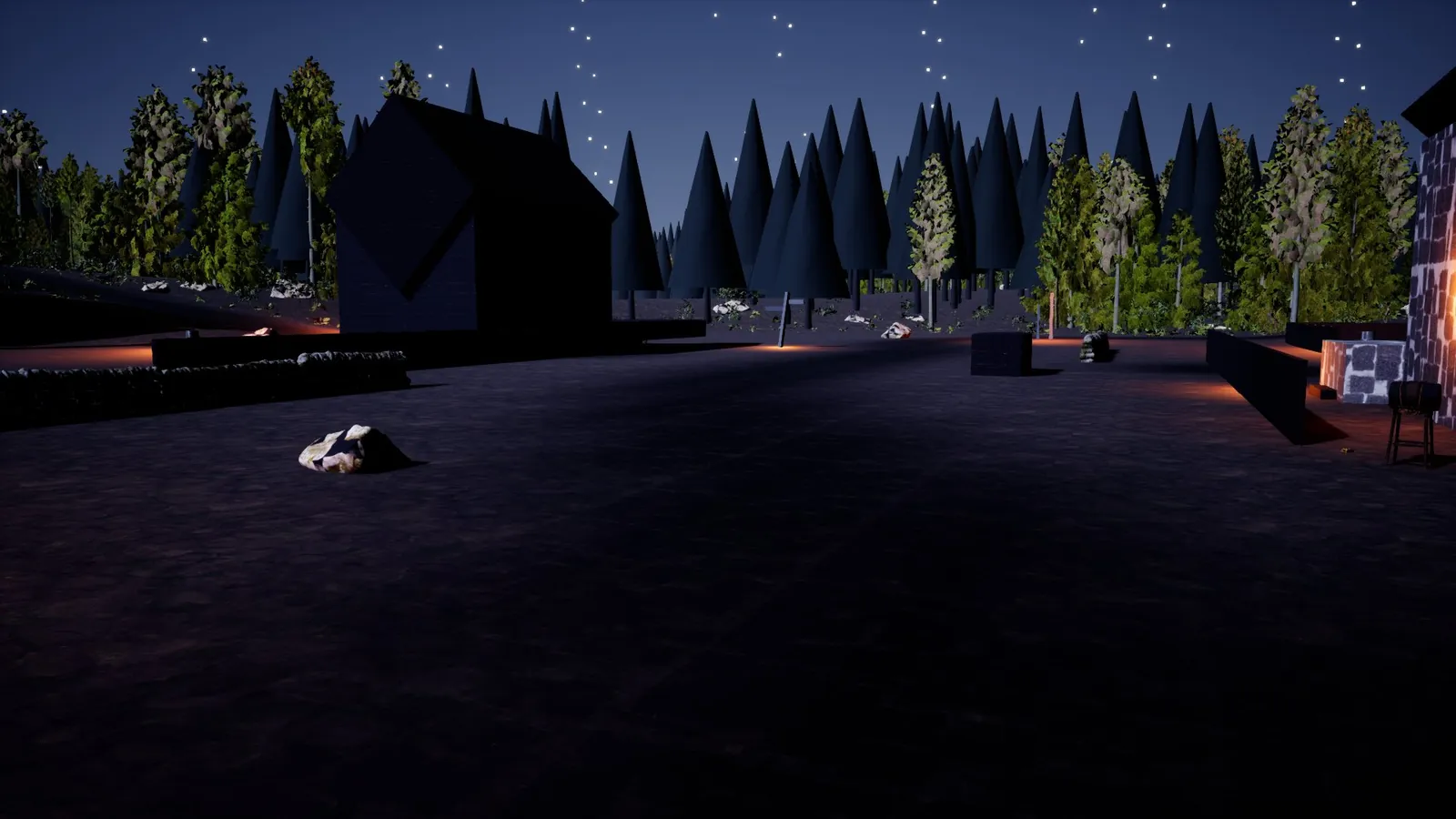
The farm after the night pass. Braziers mark the way, and the fog hides the edges.
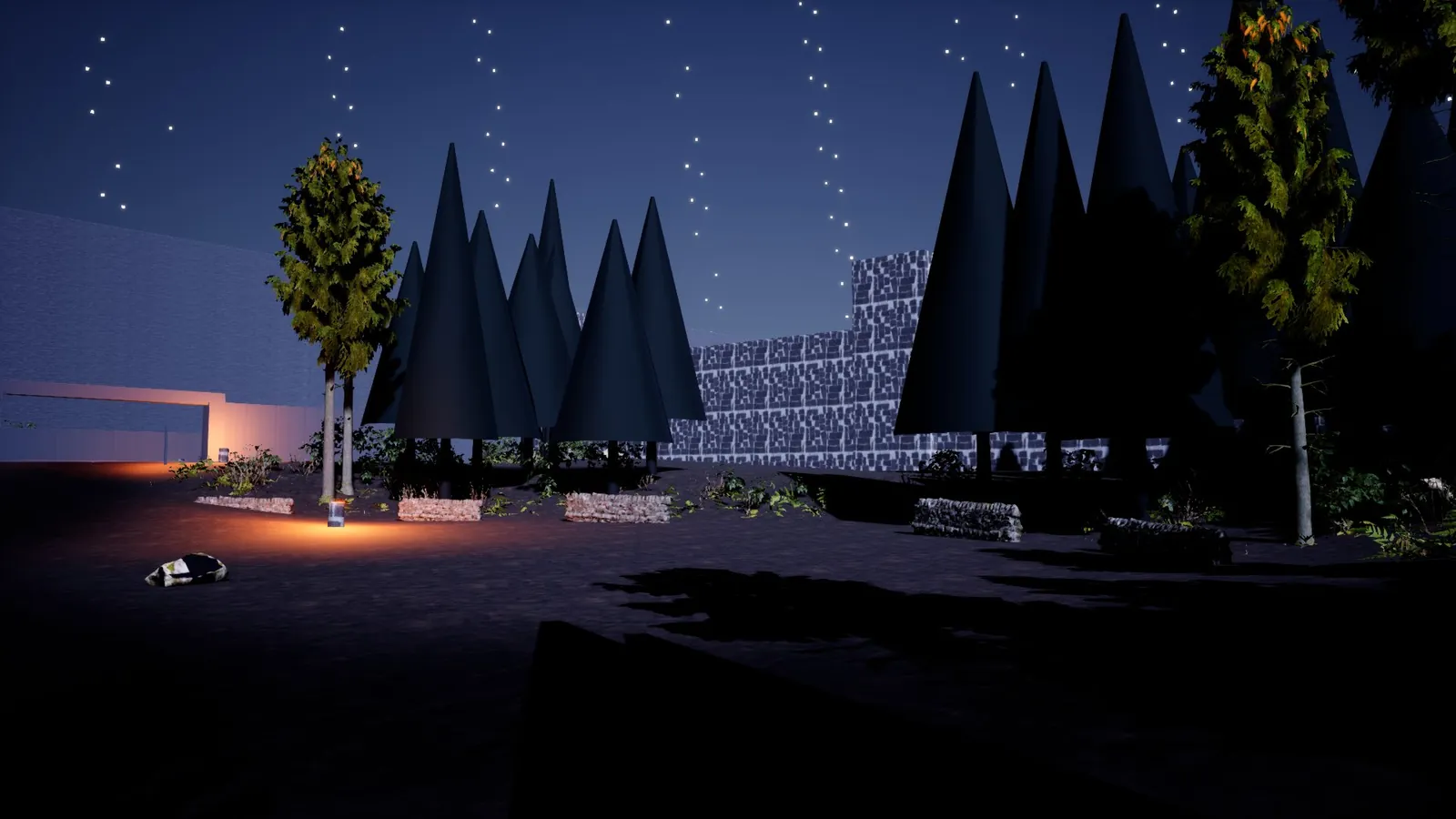
The boss arena before the village gate. This is where the Thorn Hulking waits.
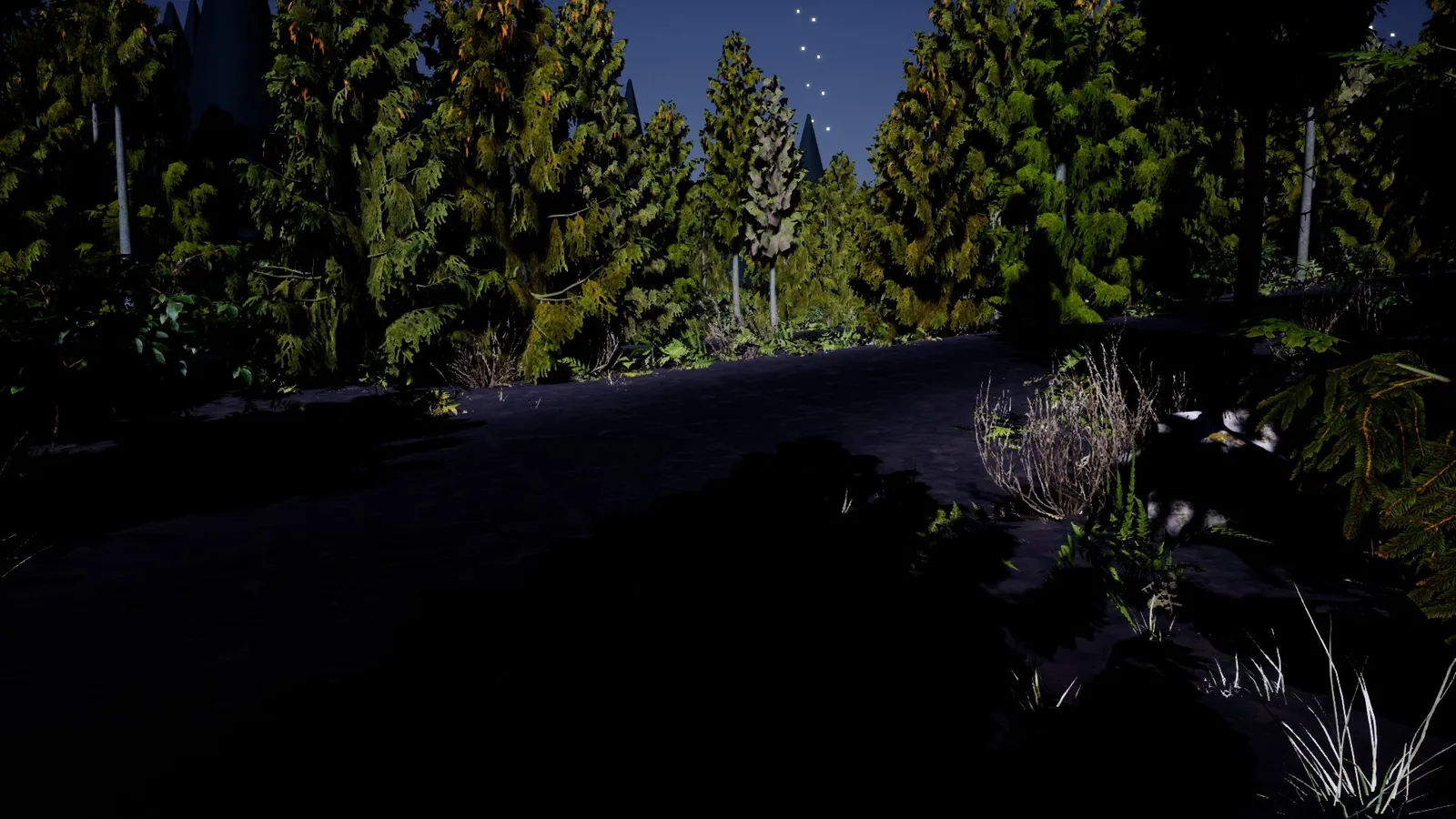
The field road at night. You need to see Thralls coming, but not much further.
The front end now flows into a playable run (PR #107): a splash screen, the title, single player, a lobby where you pick your hero, difficulty and bots, then Segment 1. Escape opens Resume, Settings, Restart from checkpoint, Leave to title and Quit. A thread packaged it all into a build with a “Left for Mead” shortcut on Joel’s desktop, so he can play it like a real game.
The bots now spread out (PRs #108 and #111). Each one takes a spot a few metres off the leader’s path, keeps its own personal space, lags or leads a little depending on its personality, and wanders over to look at nearby loot when things are quiet. When a threat appears, they close back in.
The Briar Warden apparitions went in (PR #115). The druid now appears at a distance at key moments along the route, the way it will on the village walls.
And a batch of Rodin props arrived (PR #116): four shields, three helmets that fit every hero, a bandage, a tankard, a bottle, a bear trap, a thorn kit, a crossbow bolt and a war hammer. Nine armour pickups followed, with chest, gloves and boots for each tier, so every pickup in the game now has a real model. Each item started as a Meshy concept picture and became a 3D model in Rodin, and the whole batch used about 22 of the 208 Rodin credits from the jam perks.
More Thralls, more armour
So that a horde doesn’t look like a crowd of clones, Claude wrote prompts for five new cursed villagers, each with a different build, age and mutation: a milkmaid, a heavy farmhand with a root mass growing out of his back, an old widow crowned with twigs, a blacksmith’s boy with thorns along his spine, and an alewife with bark plates across her chest. Joel generated turnaround sheets for all five in ChatGPT and liked every one of them. They’ll go through Tripo as credits allow, once the hero armour is done.
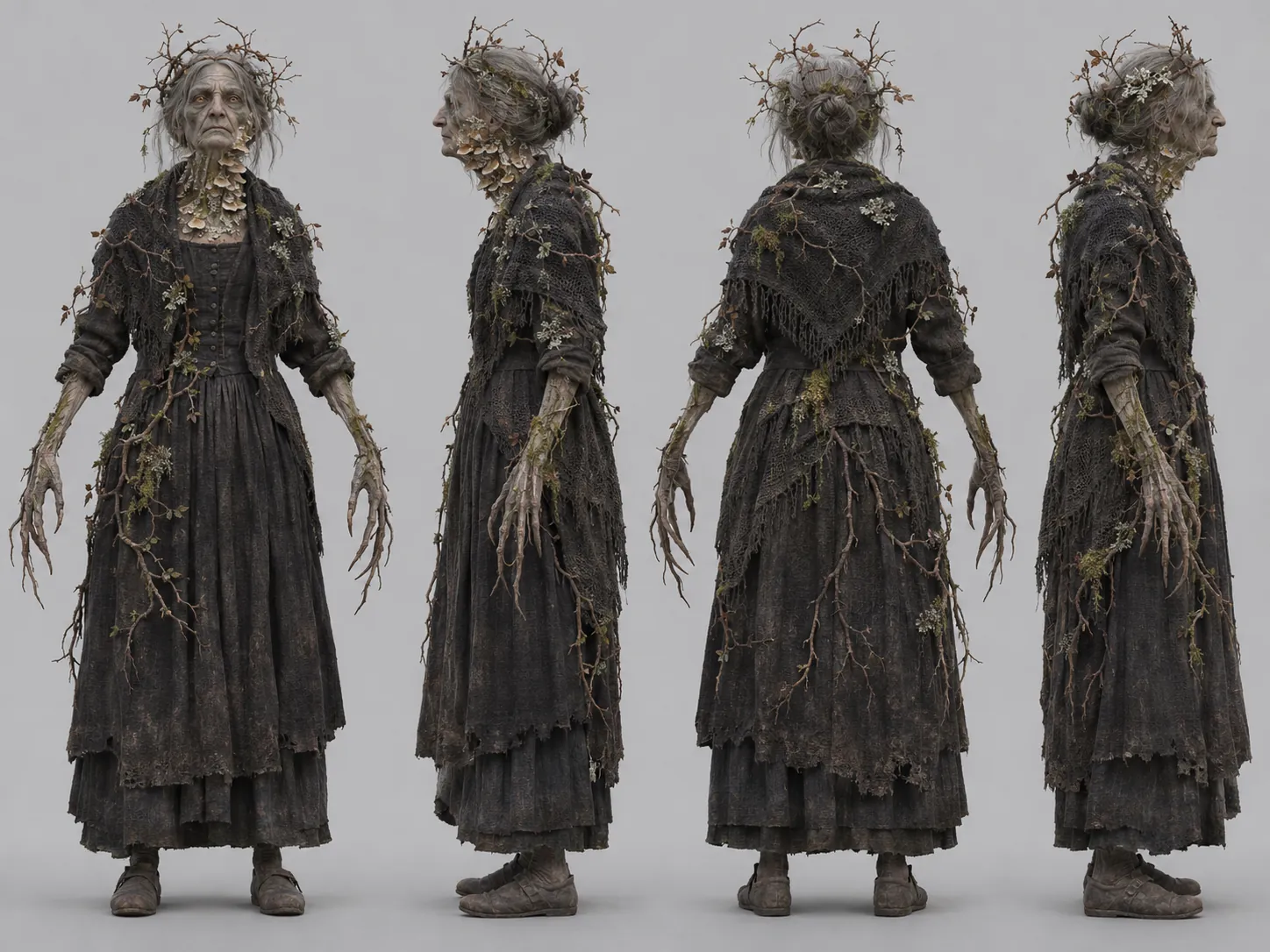
The widow Thrall’s turnaround sheet, generated in ChatGPT from Claude’s prompt. It’s the input for Tripo, not a finished model.
Meanwhile Joel has been working through the hero armour himself. The Guard’s mail is in Blender now, on its way to Unreal, with seven more armour sets lined up behind it.
The hard parts (so far)
The night pass broke the spawn. Changing the lighting and terrain for the night moved Segment 1’s player start, so you now begin the run in empty fog, far from the route. It’s the biggest problem in the game right now, and the fix is the top priority. Until it lands, Joel’s desktop shortcut stays on the last good build, which already has the new bots and fixed menus.
A black first launch. The first desktop build showed a black window for about 30 seconds before anything appeared, and some menu labels spilled out of their buttons. Both are fixed (PR #110): the splash now shows after about 3 seconds, and the labels fit.
A frame-rate scare. An early performance test reported 44 fps, which looked bad against our 60 fps target. It turned out the test had run at 4K. At a true 1080p the build runs at about 100 fps, so we could all breathe again.
Bots bumping shoulders. When two bots wanted the same spot, they could still end up pressed together. A follow-up fix guarantees each bot its personal space (PR #111).
Codex waiting on a sentence. Codex got stuck on the Briar Warden and the Bramble Runner with design questions. Claude answered them, but the safety check on Joel’s PC wanted each new run named explicitly in Joel’s own words before it would start them. It took two rounds of “please paste this” before Codex was moving again.
Free shields that weren’t quite free. Some free shields on Fab needed Joel to accept an extra Epic agreement before they could be downloaded. Rather than hold things up, Rodin made all four shields instead.
Tools we used, and for what
Codex CLI built the menus, the director’s specials, the Strawman and the Warden’s apparitions. Claude Code Desktop on Joel’s PC did the night pass, the castle rebuild, the bot changes and the desktop builds. Meshy and Hyper3D Rodin made the props and armour pickups. ChatGPT turned Claude’s prompts into Thrall turnaround sheets, and Tripo and Blender turn sheets like these into game-ready characters.